

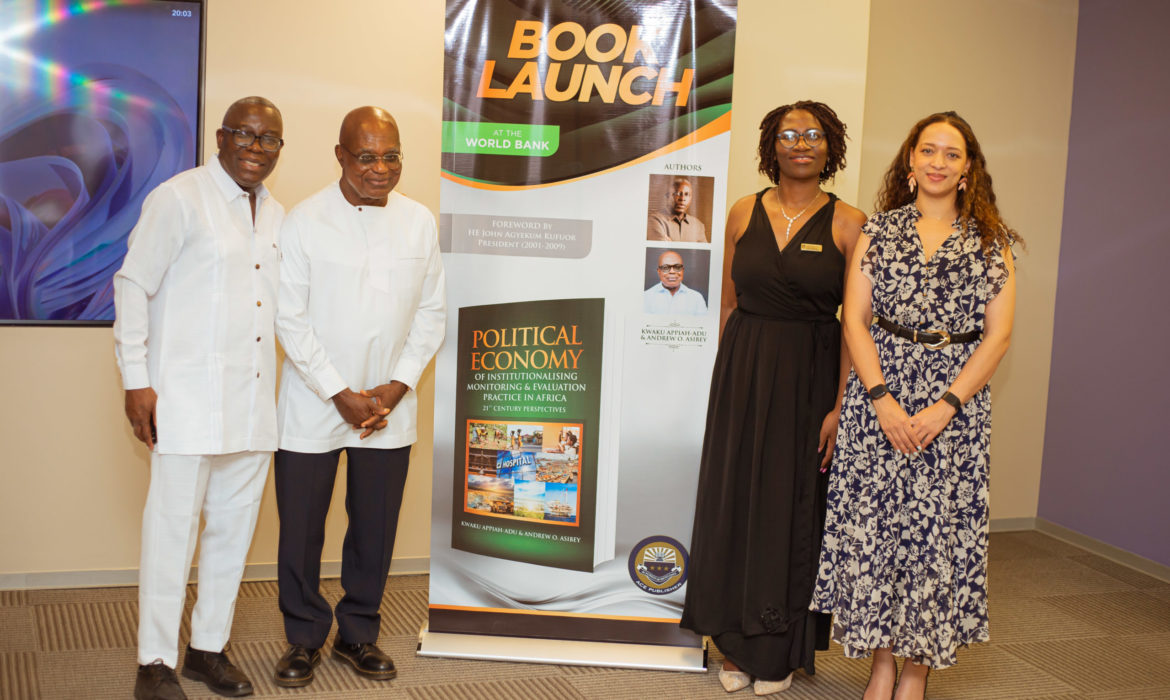
Policymakers, development practitioners, academics, and governance stakeholders gathered at the World Bank Country Office in Accra on Wednesday, 10th June 2026, for the launch of Political Economy of Institutionalising Monitoring & Evaluation (M&E) Practice in Africa: 21st Century Perspectives. Co-authored by renowned M&E specialists Professor Kwaku Appiah-Adu and Mr. Andrew Osei Asibey, the book promises to substantially enrich discourse on governance, accountability, and sustainable development across the continent.
The book was supported financially by Twende Mbele – a Pan-African organisation of African governments using evaluation to improve service delivery to their citizens. The book launch brought together a distinguished assembly including Ghana’s former Vice President H.E. Dr. Mahamudu Bawumia as Guest of Honour. Mr. Patrick Awuah, founder of Ashesi University, chaired the launch and emphasised that the book “speaks directly to policymakers, practitioners, and citizens alike,” calling for “a shift – from compliance to learning, from reporting to impact, and from data collection to decision-making”. He stressed that the launch should mark the beginning of a conversation on how Africa can strengthen governance systems and enhance the well-being of its people.
A Fresh Perspective on M&E
What sets this book apart is its bold reframing of M&E from a narrow technical function into a broader governance and political economy issue. The authors draw on over two decades of practical experience, interviews with policymakers across four Ghanaian administrations (2001–2025), and case studies from South Africa and Uganda to trace the evolution of Ghana’s M&E architecture – its successes, limitations, and the reforms needed to strengthen it.
At the heart of the book lies a powerful argument: the problem in Africa is not the absence of data or M&E systems, but the failure to use evidence for learning and decision-making. This is captured in what the authors describe as the “data paradox” – the reality that countries like Ghana have become increasingly proficient at measuring activities, yet remain relatively weak at learning from those measurements.
Key Insights for Practitioners and Policymakers
The book explores the political, institutional, and socio-economic factors that influence the successful institutionalisation of M&E systems. It distinguishes between building systems (supply) and ensuring their use (demand), and examines the role of digitalisation, big data, and artificial intelligence in transforming M&E practice. Crucially, it recognises that leadership commitment matters, incentives shape behaviour, political transitions affect continuity, and evidence is not always neutral in decision-making. From a practitioner’s standpoint, the book offers practical reforms to strengthen both the technical and institutional dimensions of M&E.
A Crucial Contribution
As Ghana’s former Vice President Bawumia noted, the book arrives at a crucial moment – “an era shaped by data, digital transformation, and increasing” demands for accountable governance. For anyone who believes that good governance begins with measurable evidence, this book is an essential read. It sets a new benchmark for thinking about M&E in Africa and will influence debates among policymakers, evaluators, and scholars for years to come.

 CreativeBox
